Assembly Member Scout Teams Up With MAGA Member Handeland to Gatekeep Who Can Run For Office
The ill-conceived ordinance would impose sweeping, unprecedented changes to Anchorage election law.

If you look closely, you'll see a provision tucked into AO 2026-116 that would make it considerably more difficult (even impossible in some cases) for anyone to get their name on an Anchorage ballot. Well, that is, unless you've been deemed desirable by two of the most junior members of the Anchorage Assembly.
The bit you're looking for is sitting in Section 2, between a proposed change about newspaper notices and a change about who can file eligibility complaints.
Here's what it would mandate. Anyone running for Mayor, Assembly, or School Board would need to submit a nomination petition with their declaration of candidacy, signed by qualified voters equal to at least one percent of the number of people who cast ballots in the last regular election for that specific seat. Miss the number, and you won't make the ballot.
The sponsors of this drivel are far-right confabulator and George Martinez Fan Club President, Donald Handeland, and Sydney Scout - both of whom were sworn in just five months ago.
The memo supplies its own examples, so let's use them! A mayoral candidate at the next election would need 715 valid signatures. A School Board candidate for Seat E would need 642. An Assembly candidate in District 1 would need 56. In District 6, 131. Same one percent, applied to wildly different denominators, producing a requirement that is thirteen times heavier in some races than others. Because the divisor is turnout in the last race for that seat, the barrier climbs highest in the districts where people already vote the most and drops lowest where they don't. If the stated goal is to screen out candidates who lack real community support, then the math is running in reverse.
Alaska's own statewide petition system, the one the sponsors point to as "precedent," at least understood this problem. Under AS 15.25.180, a nominating petition could not contain fewer than fifty signatures for any district, precisely so that a low-turnout seat wouldn't end up with a meaningless threshold. Anchorage's version has no floor and no ceiling. It just takes one percent of whatever happened last time and calls it a day.
The real barrier is the calendar
The ill-conceived ordinance, which would make sweeping and unprecedented changes to Anchorage election law, moves the candidate filing window from 81 to 67 days before a regular election out to 88 to 74 days. For an April 7 election, that puts the filing period around January 8 through January 22.
The petition has to be submitted with the declaration, not after it, so there is no filing and then gathering. A mayoral candidate would need to collect 715 signatures that survive verification inside that window, which in practice means knocking on enough doors to bring in nine hundred or a thousand raw. Without question, the ordinance intends to push out anyone without an existing volunteer list, a donor base, or the cash to hire signature collectors.
It rewards only the candidate who has run before, and the candidate the local party apparatus has already picked, and it punishes the schoolteacher who decides in December that somebody ought to run.
We just spent a summer arguing the other side of this
A little more than ten weeks ago a slew of Alaskans spent energy defending a retired Petersburg schoolteacher's right to appear on a ballot. The Division of Undemocratic Elections had thrown Dan J. Sullivan off for being a "bad faith" candidate - and the argument in Court as well as the court of public opinion was that voters get to decide who is frivolous - not an official with a MAGA red-colored pen.
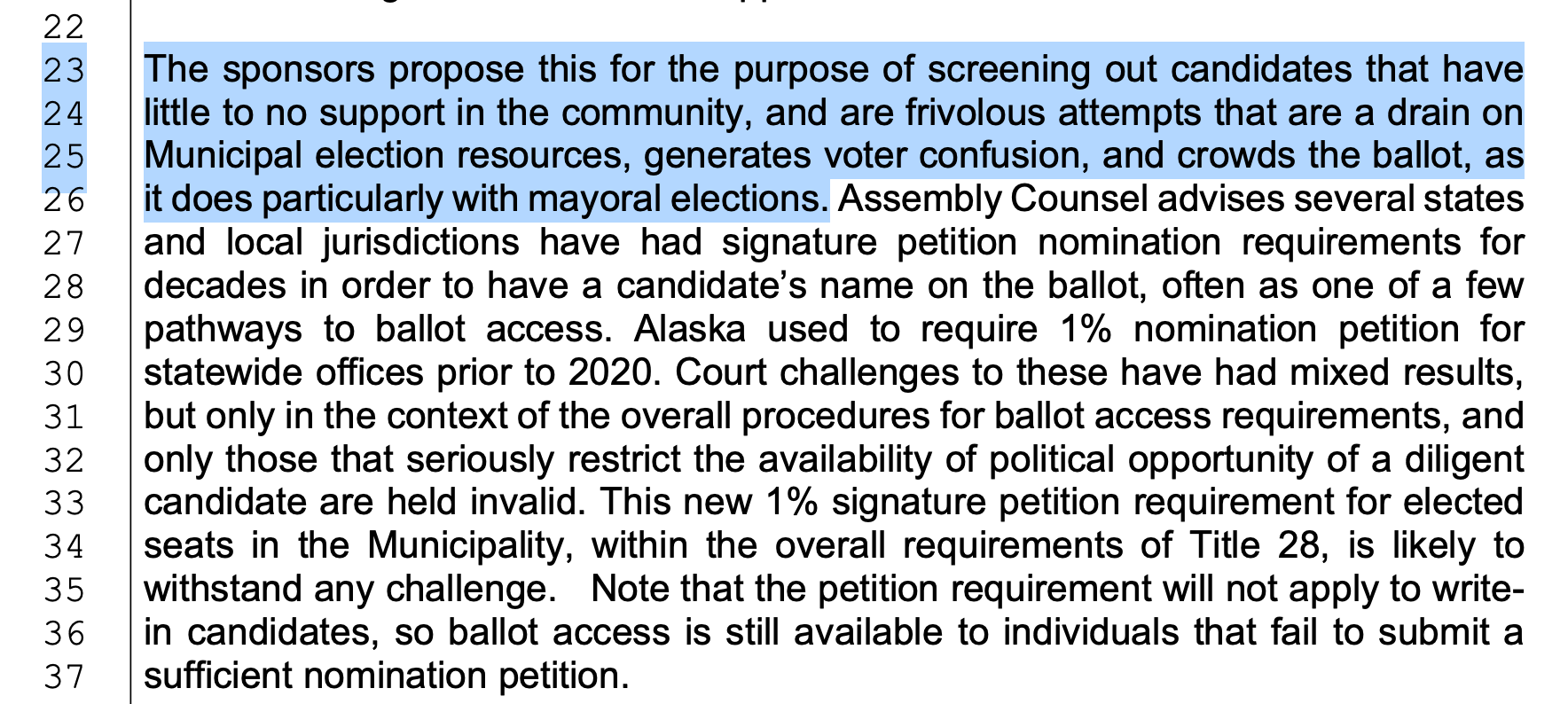
Now read the memo behind AO 2026-116, which proposes this lunacy to screen out candidates the sponsors claim have little to no support in the community, drain election resources, and generate voter confusion and crowd the ballot.
Sound familiar? It should. It's close enough to Undemocratic Elections Director Carol Beecher's argument to be uncomfortable. It is a blatant, disgusting attempt at gatekeeping.
What about the teacher who decides in December to run for School Board and needs 642 signatures citywide, on her own time, from a job where she can't campaign on school property?
What about the challenger who files after an incumbent announces retirement, and gets days to do what the incumbent could have been doing since October?
The most significant change to ballot access in Anchorage since unification arrives as Section 2 of an Omnibus about newspaper ad buys, carried by two members with five months on the job, one of whom once said she didn't support charter schools. Riveting stuff.
Worth noting: Scout won District 1 in April with 3,484 votes out of 6,007 cast, in a four-way race that included Nick Danger at 325 votes and Max Powers at 224. It seems pretty clear that those are the candidates the ordi describes, except the ballot held up just fine. The voters sorted it out in the time it takes to make a sandwich.
Also worth noting is that Scout's district would carry the lightest threshold in the city, 56 signatures, while a mayoral hopeful gets handed 715 and a school board candidate roughly that same amount.